English
 中文简体
中文简体 Español
 Deutsch
information to be updated

Product Categories
- Mobility Scooters
- Electric Wheelchairs
- Sightseeing Scooters
-
Recreational scooters/Golf Cart
-
Accessories
Semi-enclosed Mobility Scooters
Its open or semi-soft enclosed body ensures excellent visibility and airflow. The sturdy canopy frame provides effective protection against rain and harsh sunlight. Compared to fully enclosed models, it is lighter, more agile, and offers greater value, while providing far more protection than open-style scooters. It is the ideal choice for dealing with changeable conditions like spring showers or summer heat, ensuring composed and prepared travel every day.
ABOUT
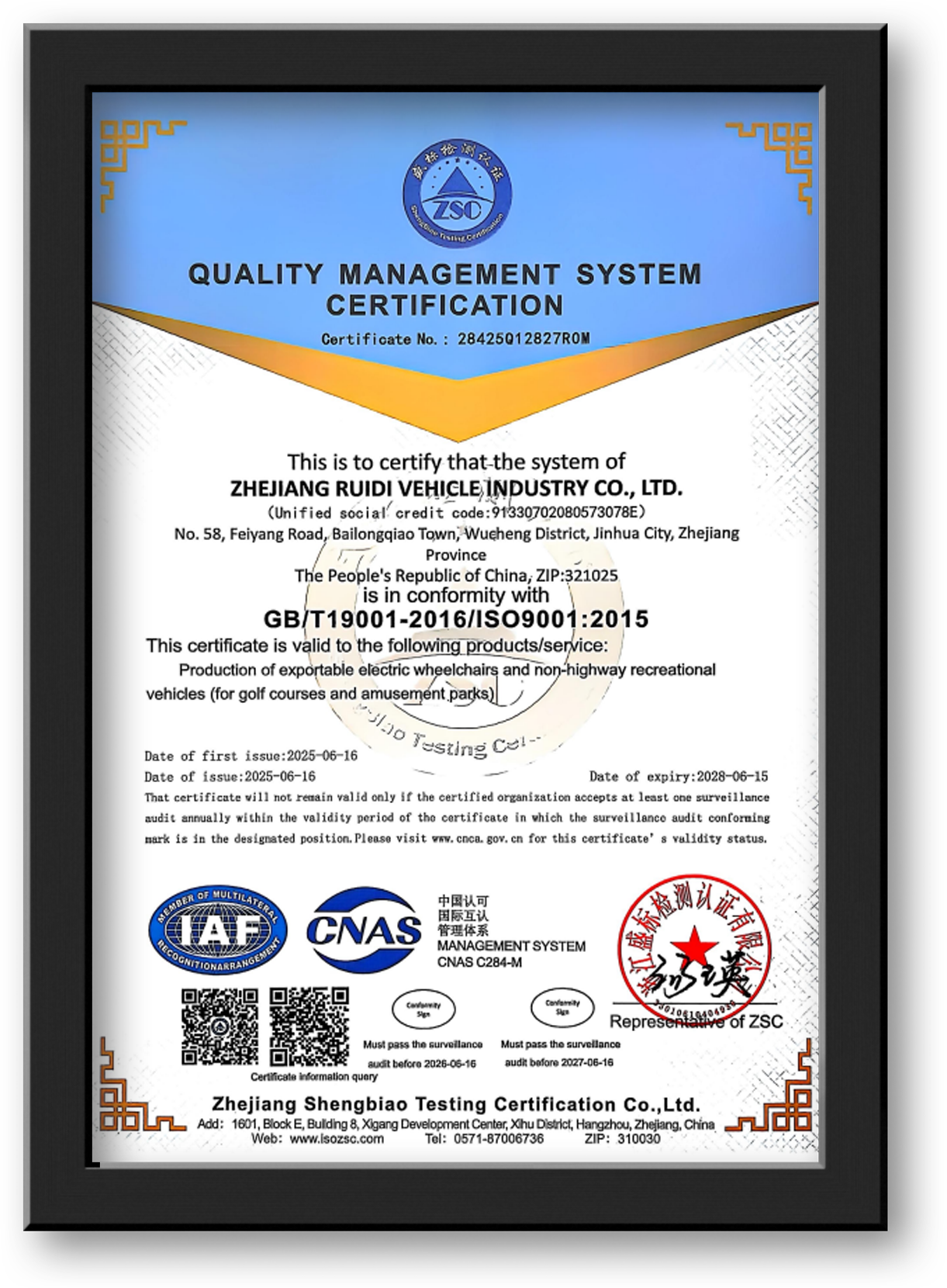
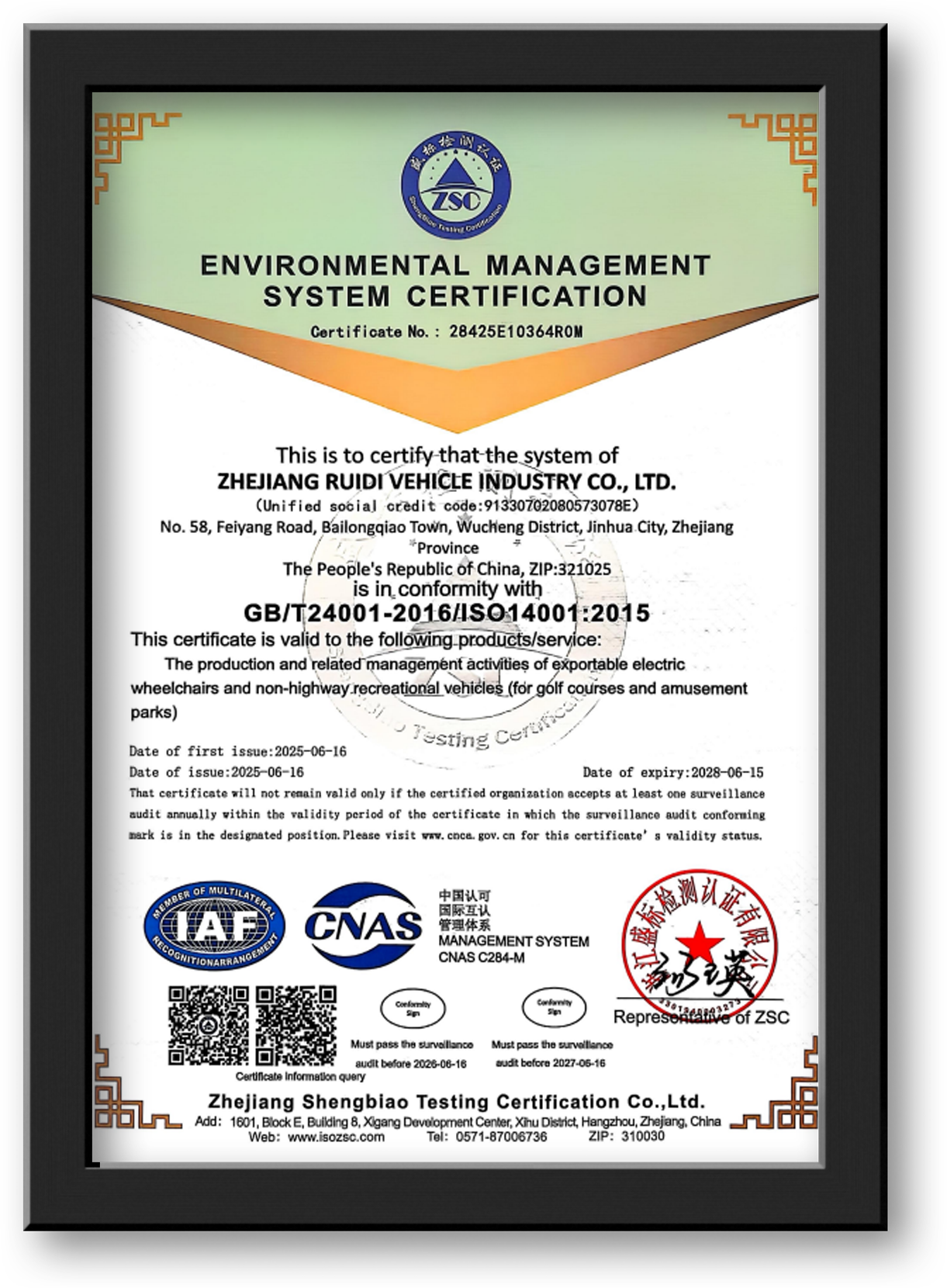
Zhejiang Ruidi Vehicle Industry Co., Ltd.
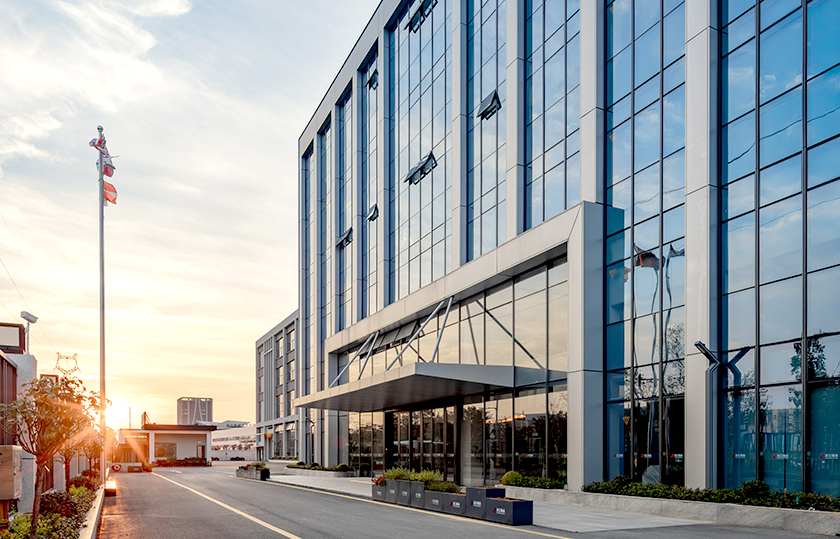
Zhejiang Ruidi Vehicle Industry Co., Ltd. is a professional manufacturer engaged in the research, development, and production of Semi-enclosed Mobility Scooters. Our products are widely applied in elderly mobility, sports and leisure, and recreational fields.
The company’s manufacturing base is located in Jinhua Industrial Park, Zhejiang Province, covering an area of approximately 35,000 square meters. The facility is equipped with over 100 sets of advanced production equipment and four efficient production lines, ensuring stable production capacity and reliable product quality.
At present, our products are exported to the United States, Canada, Europe, and Australia, as well as supplied to the Chinese domestic market. Our main product series include mobility scooters for the elderly, electric walking chairs, foldable electric mobility scooters, and enclosed cabin-type electric mobility scooters.
We consistently adhere to a quality-centered management philosophy and are supported by a professional and efficient team. We are committed to providing electric mobility products that are easy to operate, energy-saving, environmentally friendly, low-noise, and pollution-free. We believe these products bring greater comfort, convenience, and freedom to elderly and mobility-impaired users, helping them enjoy a higher quality of life.
View More
Patent Certificate
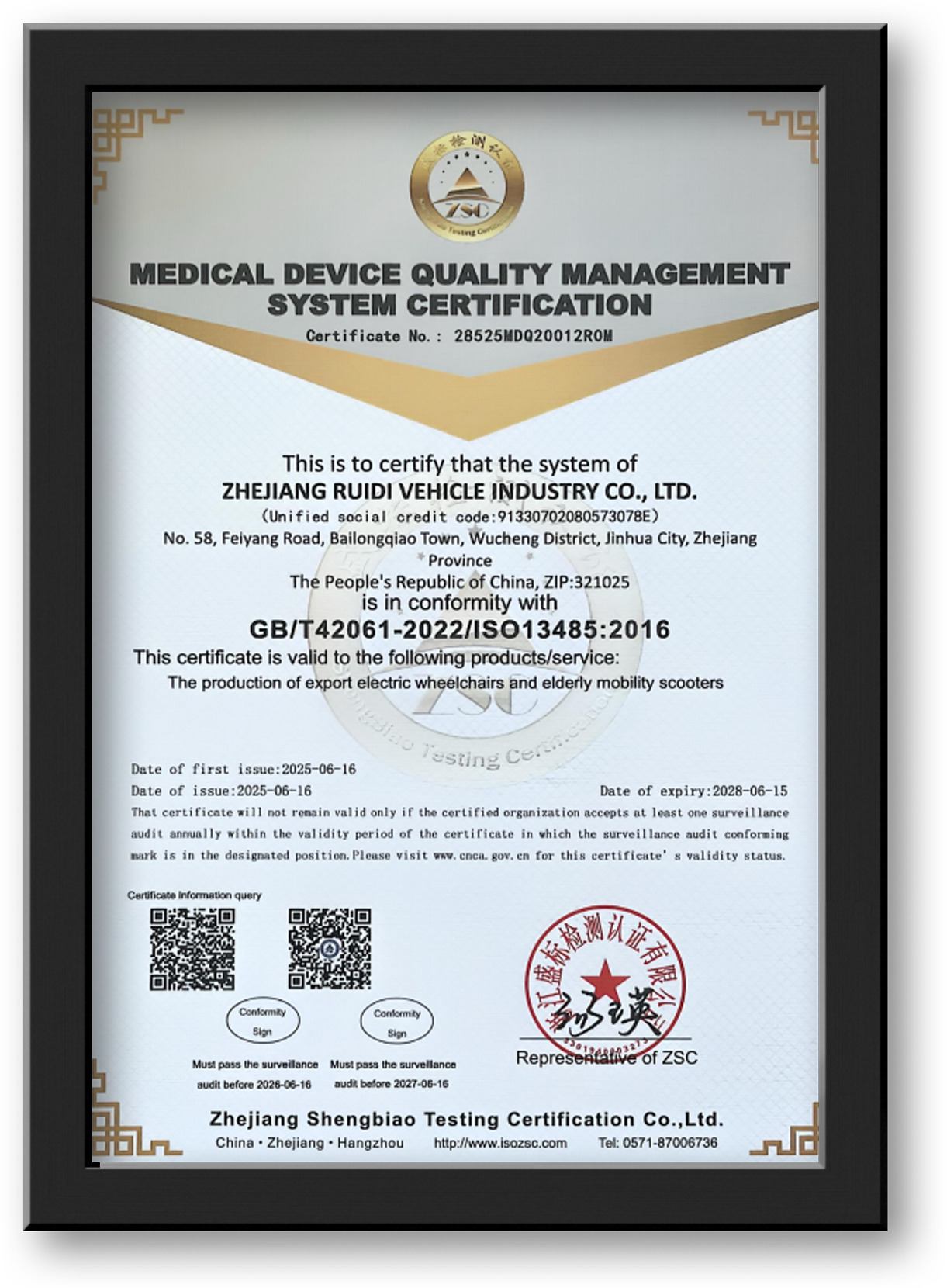
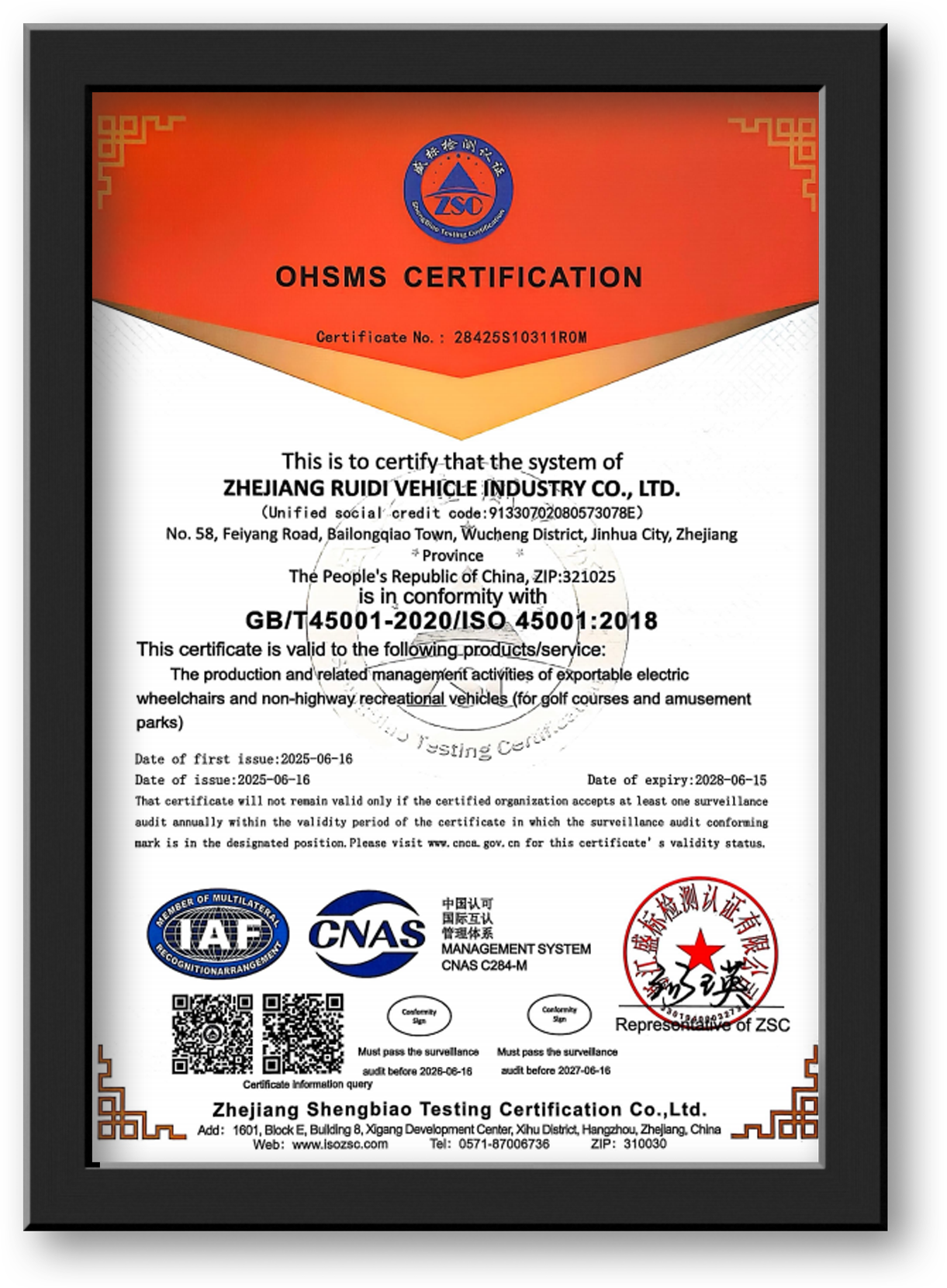
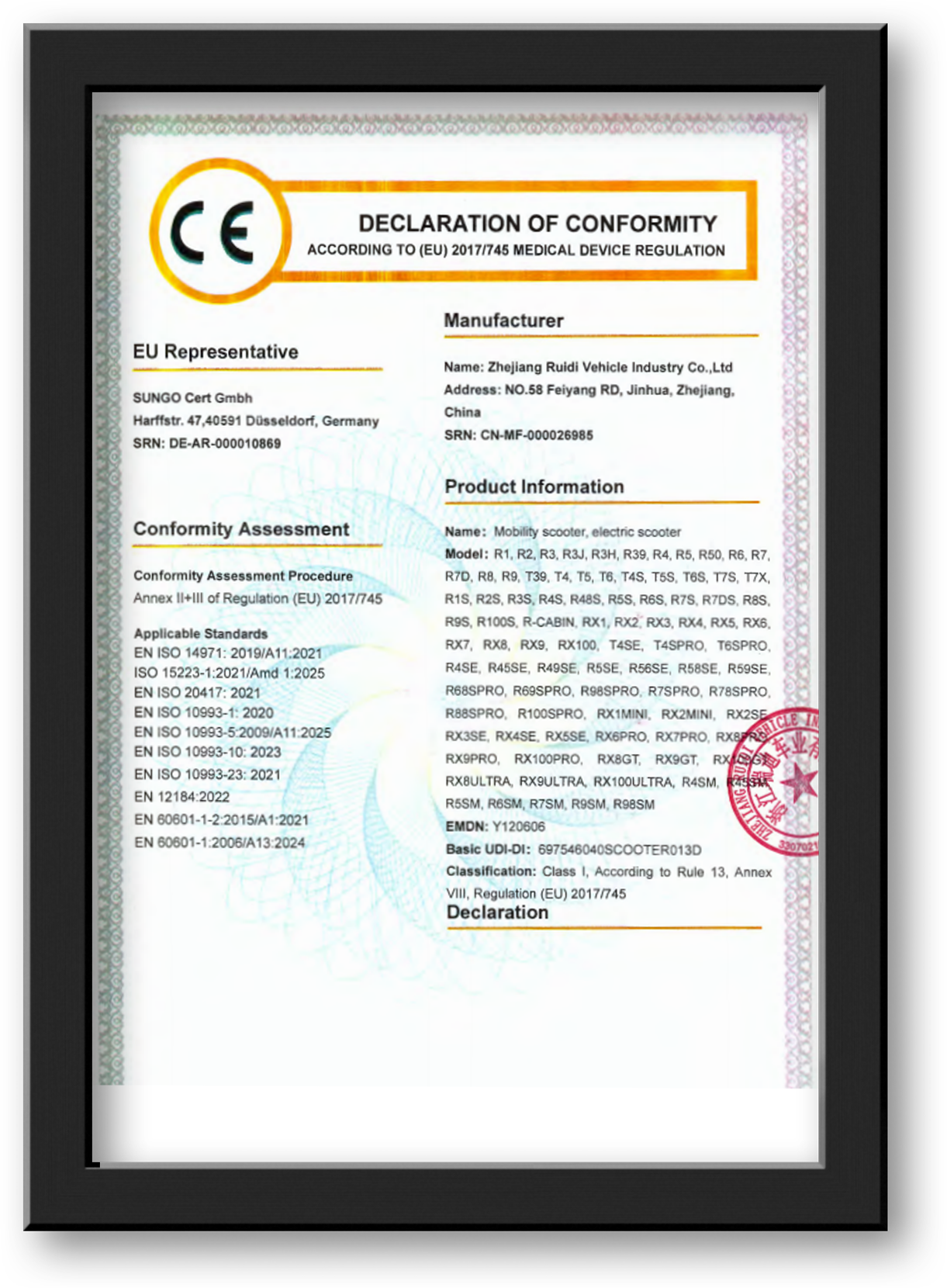
Latest Updates
View More-
2026.07.17
When Should A Senior Consider A Mobility Scooter For Elderly Use?
A parent skipping the grocery run because the parking lot feels too far, or a grandmother declining a family outing because standing in line...Read More -
2026.07.10
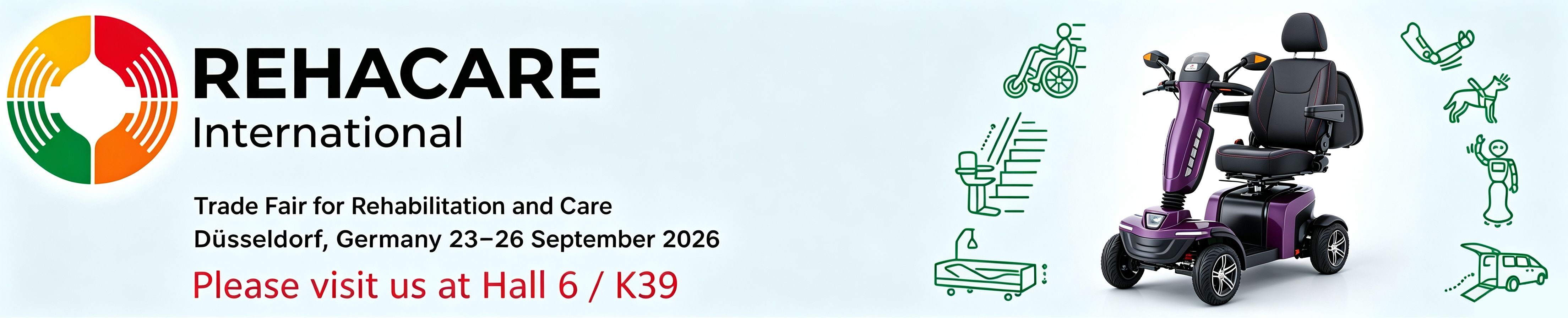
Ruidi Mobility to Attend REHACARE 2026
We are pleased to announce that Ruidi Mobility will participate in REHACARE International Trade Fair for Rehabilitation and Care 2026, one ...Read More -
2026.07.10
How Does Enclosed Mobility Scooter Improve Daily Travel?
Enclosed mobility scooter is becoming part of everyday transportation for people who want to remain active while reducing the physical effor...Read More -
2026.07.03
Who Actually Needs A Mini Electric Wheelchair?
A worn-out shoulder from folding a bulky wheelchair into a trunk, or a narrow apartment hallway that a full-size chair simply won't clear, i...Read More
Industry Knowledge
The Semi-Enclosed Mobility Scooter occupies a niche between open-style and fully enclosed mobility scooters; it is a mobility device centered on the core design philosophy of providing "partial environmental protection while maintaining open transparency." Unlike Fully Enclosed Mobility Scooters—which prioritize complete isolation from the external environment—the semi-enclosed structure places greater emphasis on striking a balance between comfort, protection, and lightweight design.
Partially Enclosed Mobility Scooters: The Engineering Logic Behind Structural Compromise
The core design concept of the Partially Enclosed Mobility Scooter is "prioritized localized protection"—that is, shielding against only the critical environmental factors rather than completely enclosing the space.
1. Canopy and Protective Structure Design
A semi-enclosed structure typically comprises:
- A lightweight canopy (for rain protection and sunshade)
- A front windshield (to reduce headwind impact)
- Partial side panels (to guard against splashes and low-speed airflow)
This structural configuration enables the vehicle to maintain an open field of view while possessing basic capabilities to adapt to varying weather conditions.
2. Airflow and Thermal Comfort Optimization
Unlike fully enclosed models, the Partially Enclosed structure retains numerous pathways for natural air circulation; consequently:
- No complex air conditioning system is required.
- Internal temperature rise remains relatively low.
- It is well-suited for prolonged use at low speeds.
The engineering focus shifts from "airtightness control" to "airflow guidance." Examples include:
- Canopy airflow-deflection designs to minimize direct wind exposure.
- Open side sections that create natural convection channels.
3. Center of Gravity and Structural Stability Control
Since the overhead structure adds additional mass, the design must account for:
- The impact of a raised center of gravity on stability.
- Changes in lateral forces resulting from increased wind resistance.
- Amplified lateral forces experienced during cornering.
Therefore, the design typically incorporates:
- A widened wheelbase.
- A reinforced chassis structure to resist body roll.
- A canopy constructed from lightweight composite materials.
Redefining the Systemic Positioning of the Semi-Enclosed Mobility Scooter
The Semi-Enclosed Mobility Scooter is not merely a "compromise product," but rather the result of engineering optimization tailored to real-world operating environments. Its core objective is to "mitigate exposure to environmental risks while simultaneously preserving an open and unencumbered user experience." Its design logic primarily revolves around three key concepts:
- Protection
- Visibility
- Openness
Partially Enclosed Mobility Scooters and Environmental Adaptability Design
1. Enhanced Climate Adaptability
The semi-enclosed structure is primarily designed to address the following environmental conditions:
- Light rain
- Intense sunlight exposure
- Mild wind and dust environments
Through the design of the roof and front sections, direct user exposure to the external environment is significantly reduced.
2. Adaptability to Complex Urban Spaces
In urban environments, fully enclosed structures can:
- Restricted field of view
- A heightened sense of delayed responsiveness in handling
In contrast, the semi-enclosed design preserves:
- A 360° open field of view
- Ease of entry and exit
- Enhanced environmental awareness
3. Optimized User Convenience
The partially enclosed structure typically requires no complex entry/exit mechanisms:
- Doorless configuration or simplified door design
- Quick and easy boarding/alighting
- Better suited for frequent, short-distance travel
Structural System Comparison: Open vs. Semi-Enclosed vs. Fully Enclosed
| Dimension | Open Mobility Scooter | Semi-Enclosed Mobility Scooter | Fully Enclosed Mobility Scooter |
| Protection Level | None | Moderate | High |
| Ventilation | Very High | High | Low |
| Weight | Light | Moderate | Heavy |
| Ease of Operation | High | High | Moderate |
| Field of View | Open | Open + Partial Shielding | Partially Restricted |
| Climate Adaptability | Low | Moderate | High |
Engineering Design Challenges: Balancing the Semi-Enclosed Structure
The primary design challenge for the Semi-Enclosed Mobility Scooter lies in managing the "coexistence of conflicting constraints."
1. Wind Resistance and Structural Stability
The canopy structure introduces:
- An increased wind resistance area
- Enhanced turbulence in high-speed airflow
Therefore, the design requires:
- A streamlined canopy profile
- Optimized structural support rods for wind resistance
2. The Trade-off Between Structural Strength and Lightweighting
A semi-enclosed structure must avoid excessive weight; otherwise, it will negatively impact:
- Acceleration performance
- Battery range
- Handling agility
Common solutions include:
- Aluminum alloy frames
- Composite material canopies
- Hollow-structure support components
3. The Conflict Between Safety and Openness
While an open structure enhances convenience, it also introduces risks:
- A lack of lateral protection
- Weaker resistance against external collisions
Consequently, the design must incorporate:
- Enhanced chassis impact resistance
- Additional soft-structure side protection elements
Expanded Use Cases
Partially Enclosed Mobility Scooters are suitable for a wide—though not extreme—range of environments:
1. Community and Campus Transit
- Senior living communities
- Medical campuses
- Large university campuses
2. Tourism and Leisure Use
- Park sightseeing
- Short-distance travel within scenic areas
- Open-air recreational zones
3. Daily Urban Mobility Assistance
- Short-distance shopping trips
- Neighborhood transit
- Light-duty commuting
As an intermediate form situated between fully open and fully enclosed designs, the core value of the Semi-Enclosed Mobility Scooter lies not in "total protection," but rather in a "flexible compromise adapted to the environment."
Specifically:
- The Partially Enclosed Mobility Scooter provides fundamental structural protection capabilities, achieving lightweight environmental isolation through the use of a canopy and partial shielding panels
- The overall semi-enclosed system enhances adaptability to complex weather conditions and urban environments while simultaneously preserving an open field of view and user convenience
The significance of this product category lies in the fact that it liberates personal mobility devices from the binary constraint of being either "fully open" or "fully enclosed," ushering them into a more dynamic, adaptable, and use-case-driven engineering space.
We'd love to hear from you!

QUICK LINKS
PRODUCTS
CONTACT INFORMATION
 No.58 Feiyang Road , Jinhua 321025, Zhejiang, China
 +86-13905796145
 [email protected]
  +86-579-82268015
High Quality Partially Enclosed Mobility Scooter
Copyright © Zhejiang Ruidi Vehicle Industry Co., Ltd. Rights Reserved.