English
 中文简体
中文简体 Español
 Deutsch
information to be updated

Accessories
To fully support the continuous and stable operation of the Ruidi product series, we offer a comprehensive range of genuine parts and carefully selected accessories. Our parts portfolio covers core components, wear items, and functional expansion products, designed to meet your maintenance, replacement, and upgrade needs during daily use. We ensure all parts meet our standards for quality and compatibility, guaranteeing an ideal fit with your Ruidi products and safeguarding their performance and safety. Furthermore, our service team can provide professional parts consultation and selection guidance. Whether for routine maintenance or adding new functions to your vehicle, Ruidi parts are your reliable and convenient choice. We are committed to being your comprehensive service partner, ensuring your Ruidi products consistently maintain their ideal condition.

ABOUT
Zhejiang Ruidi Vehicle Industry Co., Ltd.
Zhejiang Ruidi Vehicle Industry Co., Ltd. is a professional manufacturer engaged in the research, development, and production of Accessories. Our products are widely applied in elderly mobility, sports and leisure, and recreational fields.
The company’s manufacturing base is located in Jinhua Industrial Park, Zhejiang Province, covering an area of approximately 35,000 square meters. The facility is equipped with over 100 sets of advanced production equipment and four efficient production lines, ensuring stable production capacity and reliable product quality.
At present, our products are exported to the United States, Canada, Europe, and Australia, as well as supplied to the Chinese domestic market. Our main product series include mobility scooters for the elderly, electric walking chairs, foldable electric mobility scooters, and enclosed cabin-type electric mobility scooters.
We consistently adhere to a quality-centered management philosophy and are supported by a professional and efficient team. We are committed to providing electric mobility products that are easy to operate, energy-saving, environmentally friendly, low-noise, and pollution-free. We believe these products bring greater comfort, convenience, and freedom to elderly and mobility-impaired users, helping them enjoy a higher quality of life.
View More
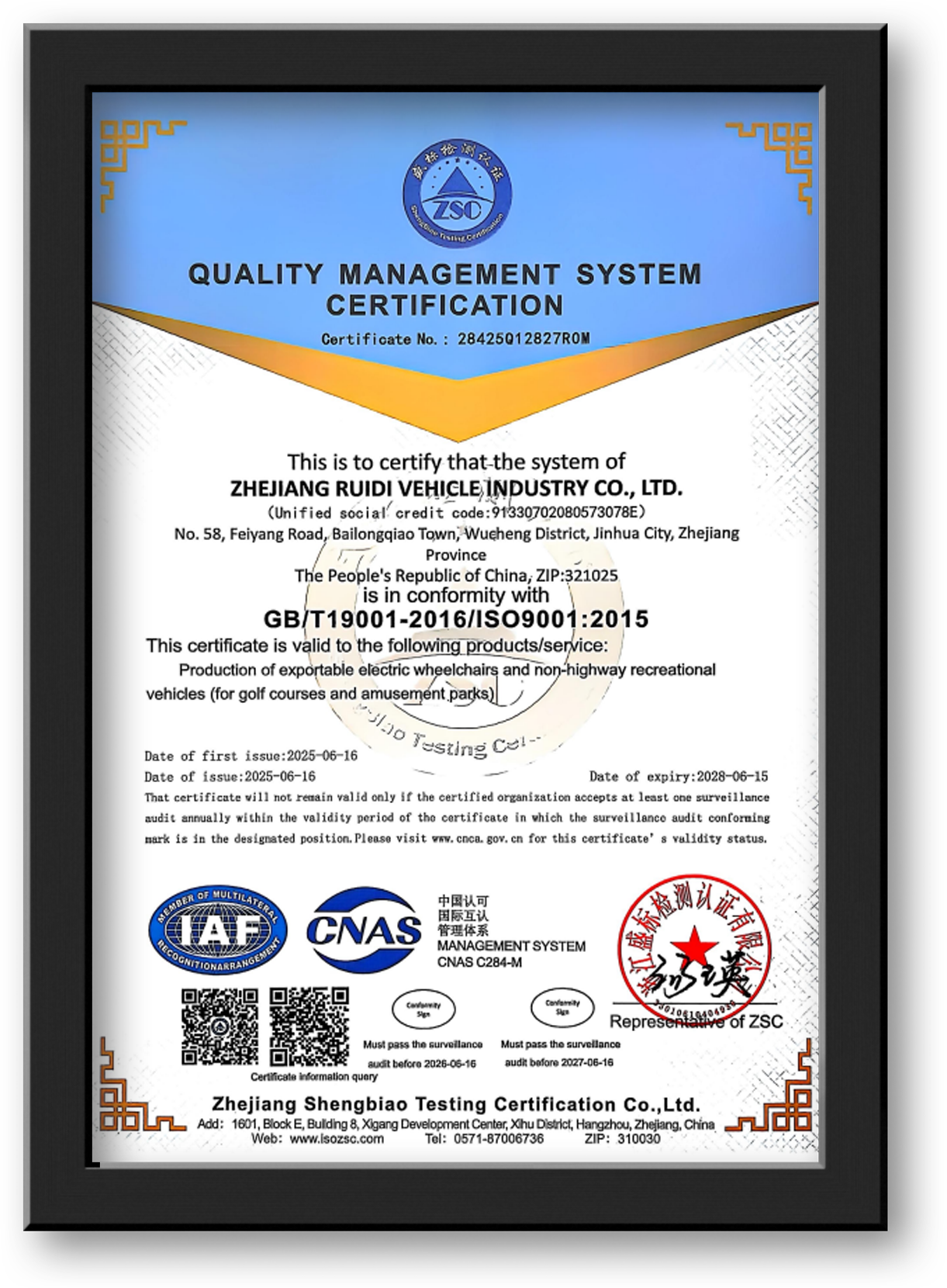
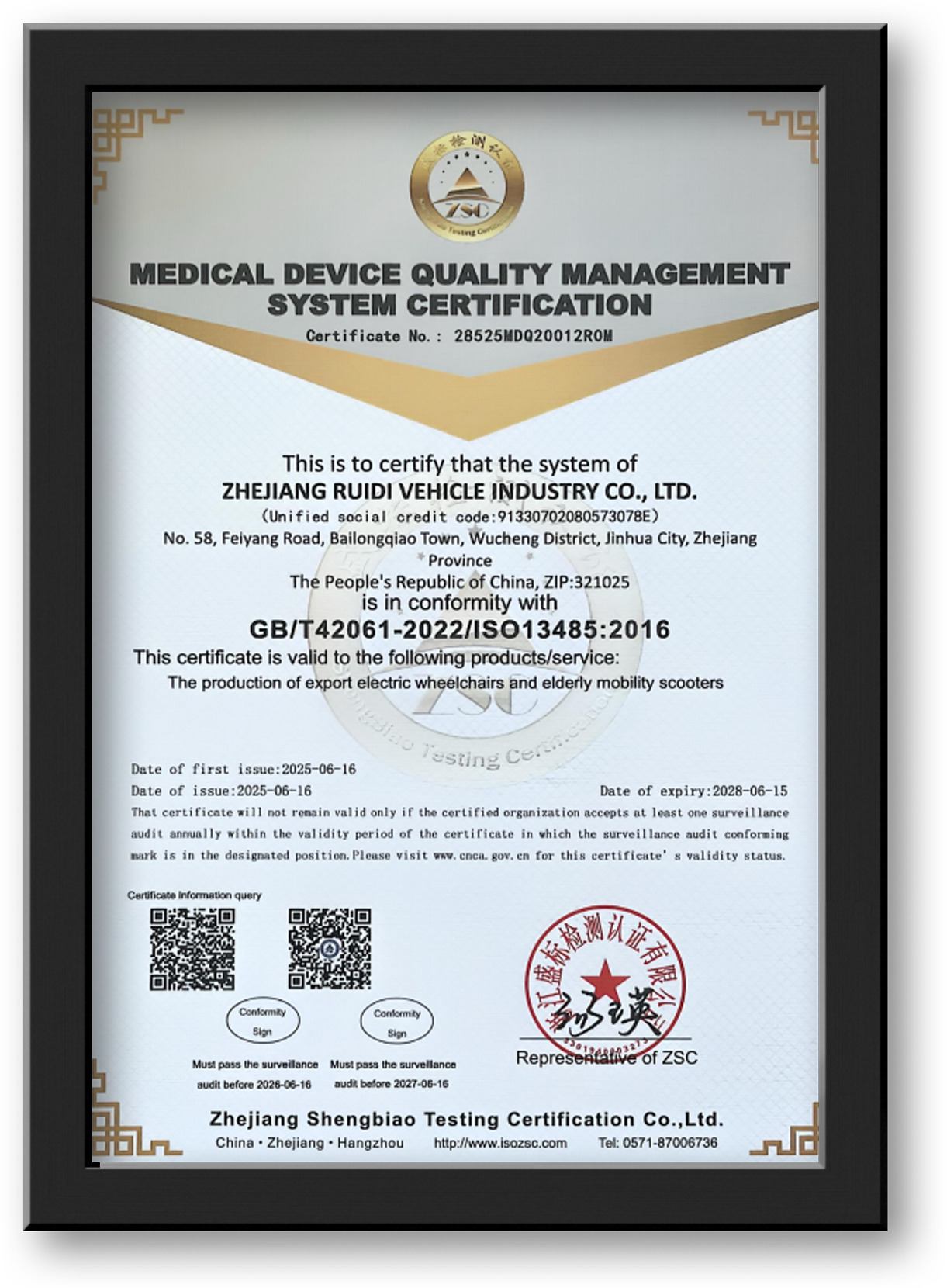
Patent Certificate



Latest Updates
View More-
2026.10.16
Travel Mobility Scooter Design Shifts Toward Outdoor Usability
A Travel Mobility Scooter designed for longer outdoor use faces different requirements from a compact model intended mainly for short local ...Read More -
2026.10.09
Small Lightweight Scooter Balances Portability With Daily Performance
A Small Lightweight Scooter is shaped by a practical balance between easy handling and usable mobility. Reducing dimensions can improve stor...Read More -
2026.10.02
How Do Factories Test Small Portable Mobility Scooters?
Testing Starts With the Folding Frame For small portable mobility scooters, the folding frame is a key part of product design. Users may fol...Read More -
2026.09.25
4 Wheel 2 Seat Mobility Scooter Expands Shared Mobility Options
A second seat changes more than the number of people a mobility scooter can carry. It changes how two people enter, sit, communicate, and mo...Read More
Industry Knowledge
Electric Vehicle Accessories refers to ancillary products associated with electric vehicles (EVs)—including charging equipment, connection cables, adapters, and maintenance components—that serve to support the charging, operation, and repair processes. These accessories enhance the convenience of EV usage and the stability of vehicle operation, constituting a vital component of the broader EV ecosystem.
Basic Composition and Functional Positioning of Charging Accessories
The scope of EV charging accessories is extensive, centering primarily on the energy replenishment process. Their core objective is to enhance charging efficiency, safety, and compatibility.
Common components include:
- Charging cables
- Interface adapters/converters
- Charging adapter modules
- Power protection devices
- Mounting brackets and fastening components
These accessories provide fundamental support across various operational environments, playing a particularly critical role in both public charging stations and home charging scenarios.
Structural Composition of the Spare Parts System
EV spare parts are primarily utilized for vehicle maintenance and functional restoration, covering a comprehensive range of components.
Common spare parts include:
- Battery module components
- Braking system parts
- Drive motor assemblies
- Tires and suspension system components
- Electronic Control Unit (ECU) accessories
These components form the foundational support system for the vehicle's long-term operation, exerting a direct influence on its service life and operational stability.
Comparative Analysis: Charging Accessories vs. Spare Parts
From a functional perspective, although both categories belong to the EV support ecosystem, they exhibit distinct differences in their primary focus.
| Comparison Dimension | EV Charging Accessories | EV Spare Parts |
| Functional Objective | Energy Replenishment | Repair & Replacement |
| Usage Frequency | High-frequency Use | On-demand Replacement |
| Technical Focus | Safety & Compatibility | Durability & Fit |
| Lifecycle | Long-term Stable Use | Periodic Replacement |
| Contextual Dependency | Charging Environment | Vehicle Maintenance Environment |
As this comparison illustrates, charging accessories are oriented more toward providing continuous support during the vehicle's active usage, whereas spare parts are oriented more toward the management of the vehicle's lifecycle.
Multi-layered Application Scenarios
- 1. Home Charging Environment
In a home-use context, charging accessories primarily fulfill basic connectivity and safety protection functions; while they are used frequently, their structural complexity is relatively low.
- 2. Public Charging Networks
Within public charging infrastructure, adaptability and compatibility emerge as critical factors, as different vehicles may require specific interfaces or adapter devices.
- 3. Repair and Maintenance Scenarios
Spare parts play a pivotal role within the maintenance ecosystem, serving to restore vehicle functionality or replace worn-out components.
- 4. Operational Vehicle Fleets
In shared mobility services or corporate vehicle fleets, spare parts management is typically characterized by a more proactive and planned approach, aimed at minimizing vehicle downtime.
Technical Development Trends for Charging Accessories
As electric vehicle (EV) technology advances, charging accessories are undergoing continuous optimization. Key trends in this area include:
- 1. Enhanced Compatibility
Charging interfaces across different vehicle models are gradually converging toward standardization or mutual compatibility to reduce usage restrictions.
- 2. Strengthened Safety Protection
Features such as overcurrent protection, temperature control, and short-circuit prevention are increasingly becoming standard configurations.
- 3. Lightweighting and Portability
Some charging devices are trending toward portable designs, making them suitable for mobile or temporary usage scenarios.
- 4. Intelligent Management
Certain charging systems are beginning to incorporate data monitoring capabilities to track charging status and efficiency.
Optimization Directions for Spare Parts Systems
The development focus for EV spare parts centers primarily on reliability and maintenance efficiency.
- 1. Increased Standardization
Component specifications are gradually becoming standardized, which helps reduce maintenance complexity.
- 2. Enhanced Durability
Key components are undergoing continuous optimization—in terms of both materials and structural design—to extend their service life.
- 3. Modular Design
Some systems are adopting modular structures to facilitate rapid replacement and repair.
- 4. Improved Ease of Maintenance
Repair procedures are being progressively simplified to boost overall operational efficiency.
Characteristics of Inventory and Supply Chain Management
Charging accessories and spare parts exhibit distinct characteristics within the context of supply chain management:
1. Charging Accessories
- Faster inventory turnover rates
- Relatively stable demand
- Lower storage requirements
2. EV Spare Parts
- Complex classification
- Significant demand fluctuations
- Requires more granular inventory management
Consequently, in actual operational practice, it is typically necessary to establish separate management systems for each category.
The evolution of EV charging accessories and spare parts systems is driving a transformation within the entire industry—shifting the focus from a "whole-vehicle-driven" model to an "ecosystem-support" model. These two categories play foundational roles in energy replenishment and equipment maintenance, respectively, and together constitute the critical pillars ensuring the long-term operational viability of electric vehicles.
We'd love to hear from you!

QUICK LINKS
PRODUCTS
CONTACT INFORMATION
 No.58 Feiyang Road , Jinhua 321025, Zhejiang, China
 +86-13905796145
 [email protected]
  +86-579-82268015
Electric Vehicle Charging Accessories Supplier
Copyright © Zhejiang Ruidi Vehicle Industry Co., Ltd. Rights Reserved.