English
 中文简体
中文简体 Español
 Deutsch
information to be updated

Foldable Mobility Scooters
Designed for seamless integration with all your travel needs. Ruidi's Foldable Scooter features a simple and quick folding mechanism. No tools are needed – it folds down and unfolds effortlessly in just a few steps. The lightweight frame makes lifting and carrying easy, and its compact folded size allows for convenient storage in a car trunk or at home. It's the ideal flexible companion for connecting with buses, trains, or car trips, ensuring continuous mobility throughout your journey.

ABOUT
Zhejiang Ruidi Vehicle Industry Co., Ltd.
Zhejiang Ruidi Vehicle Industry Co., Ltd. is a professional manufacturer engaged in the research, development, and production of Foldable Mobility Scooters. Our products are widely applied in elderly mobility, sports and leisure, and recreational fields.
The company’s manufacturing base is located in Jinhua Industrial Park, Zhejiang Province, covering an area of approximately 35,000 square meters. The facility is equipped with over 100 sets of advanced production equipment and four efficient production lines, ensuring stable production capacity and reliable product quality.
At present, our products are exported to the United States, Canada, Europe, and Australia, as well as supplied to the Chinese domestic market. Our main product series include mobility scooters for the elderly, electric walking chairs, foldable electric mobility scooters, and enclosed cabin-type electric mobility scooters.
We consistently adhere to a quality-centered management philosophy and are supported by a professional and efficient team. We are committed to providing electric mobility products that are easy to operate, energy-saving, environmentally friendly, low-noise, and pollution-free. We believe these products bring greater comfort, convenience, and freedom to elderly and mobility-impaired users, helping them enjoy a higher quality of life.
View More
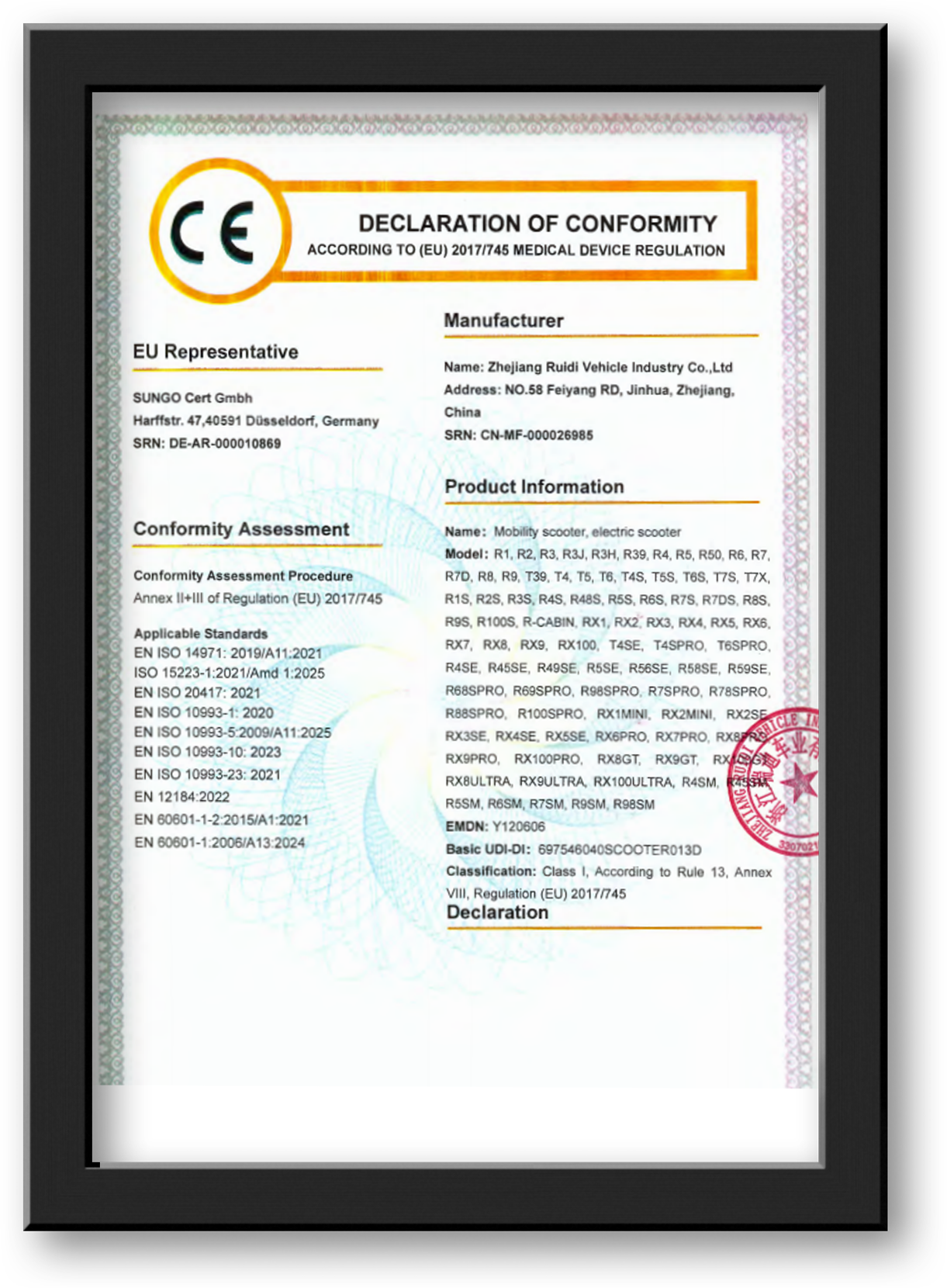
Patent Certificate




Latest Updates
View More-
2026.10.16
Travel Mobility Scooter Design Shifts Toward Outdoor Usability
A Travel Mobility Scooter designed for longer outdoor use faces different requirements from a compact model intended mainly for short local ...Read More -
2026.10.09
Small Lightweight Scooter Balances Portability With Daily Performance
A Small Lightweight Scooter is shaped by a practical balance between easy handling and usable mobility. Reducing dimensions can improve stor...Read More -
2026.10.02
How Do Factories Test Small Portable Mobility Scooters?
Testing Starts With the Folding Frame For small portable mobility scooters, the folding frame is a key part of product design. Users may fol...Read More -
2026.09.25
4 Wheel 2 Seat Mobility Scooter Expands Shared Mobility Options
A second seat changes more than the number of people a mobility scooter can carry. It changes how two people enter, sit, communicate, and mo...Read More
Industry Knowledge
A Foldable Mobility Scooter is a type of collapsible electric mobility aid designed specifically to enhance portability and maximize space efficiency. Utilizing a folding mechanism, the vehicle body can be quickly stowed away, making it easy to store in a car trunk, a corner of a room, or to transport while traveling. It is particularly well-suited for vacations, short-distance commuting, and use in environments where space is at a premium.
System Engineering Positioning of the Foldable Mobility Scooter
At its core, the Foldable Mobility Scooter is a "structurally transformable electric mobility platform." Its key design objectives include:
- Maximizing spatial folding efficiency: Minimizing the volume occupied by the device when it is not in use.
- Rapid deployment capability: Quickly transitioning from a folded state back to a fully operational state.
- Maintaining fundamental driving stability: Ensuring safe operation while simultaneously prioritizing structural lightweighting.
- Integrated and compact layout of battery and drive systems: Eliminating structural redundancy.
Compared to traditional mobility scooters with fixed structures, the design philosophy here shifts from "rigid structure optimization" to "structural state-switching optimization."
Electric Fold-Up Mobility Scooters: The Core Mechanism of the Electric Folding System
The Electric Fold-Up Mobility Scooter represents the more common technological approach within this category. Its defining characteristic is the use of electric or semi-electric mechanisms to assist the folding process, thereby reducing the physical effort required for manual operation.
1. Design Logic of the Electric Folding Mechanism
This system typically comprises the following key modules:
- Electric Actuators (Linear Actuators)
- Joint Locking Mechanisms
- Structural Hinge Systems
- Control Logic Unit
The design aims to achieve the following capabilities:
- One-touch folding/unfolding operation
- Controlled deceleration during the folding process
- Safety interlocks to prevent accidental operation
Compared to purely mechanical folding structures, the electric system significantly reduces the physical exertion required for operation, making it particularly suitable for elderly users or individuals with limited mobility.
2. Coupling of Energy Systems and Structural Design
The battery system in an Electric Fold-Up Mobility Scooter typically serves a dual function:
- Providing power for driving/propulsion
- Powering the folding mechanism
Consequently, the energy management system must meet the following requirements:
- High instantaneous power output capability (for the folding operation)
- Stable and continuous discharge capability (for driving)
- Low-battery safety protocols for folding (to prevent the mechanism from jamming mid-operation)
This dual-load design places higher demands on the Battery Management System (BMS).
3. Safety Locking and Structural Reliability
Given that the folding structure inherently involves multiple moving joints, safety design is of paramount importance:
- Automatic mechanical locking (to prevent accidental folding while in motion)
- Multi-point structural redundancy locking
- Interlock control between the folded and operational (driving) states
These mechanisms ensure that the device does not suffer from structural instability during transitions between different states.
4-Wheel Foldable Electric Scooter: Optimizing Stability in the Four-Wheel Folding Structure
Building upon the foundation of a folding structure, the 4-Wheel Foldable Electric Scooter introduces a four-wheel layout designed for stability. Its core objective is to strike a good balance between "portability" and "driving stability."
1. Stability Advantages of the Four-Wheel Structure
Compared to three-wheeled or lightweight two-wheeled folding vehicles, the four-wheel structure possesses inherent stability advantages:
- Greater resistance to tipping in a static state
- More uniform weight distribution during turns
- Enhanced adaptability to complex or uneven terrain
Consequently, it is better suited for:
- Indoor use in shopping malls
- Navigation within medical facilities
- Short-distance urban commuting
2. Integrated Design of Folding Structure and Chassis
The engineering challenge in designing a four-wheel foldable scooter lies in:
Achieving compatibility between the stable four-wheel configuration and the collapsible frame.
Common design solutions include:
- Central frame-folding structures
- Synchronized front and rear axle folding mechanisms
- Wheel-retracting folding designs
This structural approach allows the vehicle to collapse into a compact geometric form, facilitating easy transport and storage.
3. Balancing Steering Systems with Spatial Constraints
In the context of a folding design, the four-wheel structure must address the spatial requirements of the steering system:
- The front wheels typically utilize a small-radius steering mechanism
- The rear wheels maintain a fixed-position drive configuration
- The steering system is designed to avoid interference with the folding axis
This ensures that the vehicle maintains its overall stability without compromising essential steering agility.
Comparison: Electric Fold-Up Mobility Scooter vs. 4-Wheel Foldable Electric Scooter
| Dimension | Electric Fold-Up Mobility Scooter | 4-Wheel Foldable Electric Scooter |
| Core Feature | Automated Electric Folding | 4-Wheel Stable Structure |
| Operation Method | One-Touch Fold/Unfold | Semi-Automatic or Manual Folding |
| Stability | Moderate | High |
| Portability | Extremely High | Moderate |
| Applicable Scenarios | Travel, Short-Distance Transport | Urban Commuting, Mixed Indoor/Outdoor Use |
| Structural Complexity | Complex Folding Mechanism | Complex Chassis Structure |
Systems Engineering Challenges for Foldable Mobility Scooters
The design difficulty of a Foldable Mobility Scooter lies not in a single performance metric, but rather in the constraints imposed by the coupling of multiple systems:
1. Conflict between Structural Strength and Lightweight Design
Folding structures inherently present:
- An increased number of connection points
- A heightened risk of stress concentration
Therefore, they require:
- High-strength aluminum alloys or composite materials
- Enhanced hinge design to ensure long fatigue life
2. Contradiction between Volume Compression and Battery Placement
The battery is one of the modules occupying the largest volume:
- It must be embedded within the core area of the folding structure
- It must not interfere with the folding path
- It must allow for feasible removal, installation, and maintenance
3. Folding Reliability and User Safety
The folding mechanism must guarantee:
- Failure-free operation over numerous folding cycles
- Structural designs that prevent finger pinching/entrapment
- State recognition and protection against accidental operation
The core value of the Foldable Mobility Scooter lies in a "revolution in spatial efficiency." Through structural folding technology, it transforms what were originally fixed-form mobility devices into personal transportation units that are compressible, portable, and rapidly deployable.
Specifically:
- The Electric Fold-Up Mobility Scooter represents the direction of electrification and automated folding, emphasizing operational convenience
- The 4-Wheel Foldable Electric Scooter represents a path prioritizing stability and structural safety, emphasizing adaptability to urban environments
Together, these two categories drive the evolution of foldable mobility scooters from mere "portable tools" into "intelligent, space-adaptive mobility systems," endowing personal mobility devices with the true modern urban capability to be "deployed and stowed away at any moment."
We'd love to hear from you!

QUICK LINKS
PRODUCTS
CONTACT INFORMATION
 No.58 Feiyang Road , Jinhua 321025, Zhejiang, China
 +86-13905796145
 [email protected]
  +86-579-82268015
High Quality Electric Fold Up Mobility Scooter
Copyright © Zhejiang Ruidi Vehicle Industry Co., Ltd. Rights Reserved.