

 English
 中文简体
中文简体 Español
 Deutsch
Widening a chassis to fit a second seat sounds simple on paper, but it shifts the center of gravity, changes braking distance, and puts new stress on the drive system during turns — problems that only surface once the vehicle is loaded and tested. Producing a Twin-Seat Mobility Scooter that performs reliably under a two-person load requires reworking the chassis, suspension, and control logic as a connected system rather than treating the second seat as an add-on feature. Buyers comparing suppliers for this category often find that the manufacturing detail behind the frame matters more than the seat count printed on a spec sheet.
Chassis Widening and Lateral Stability
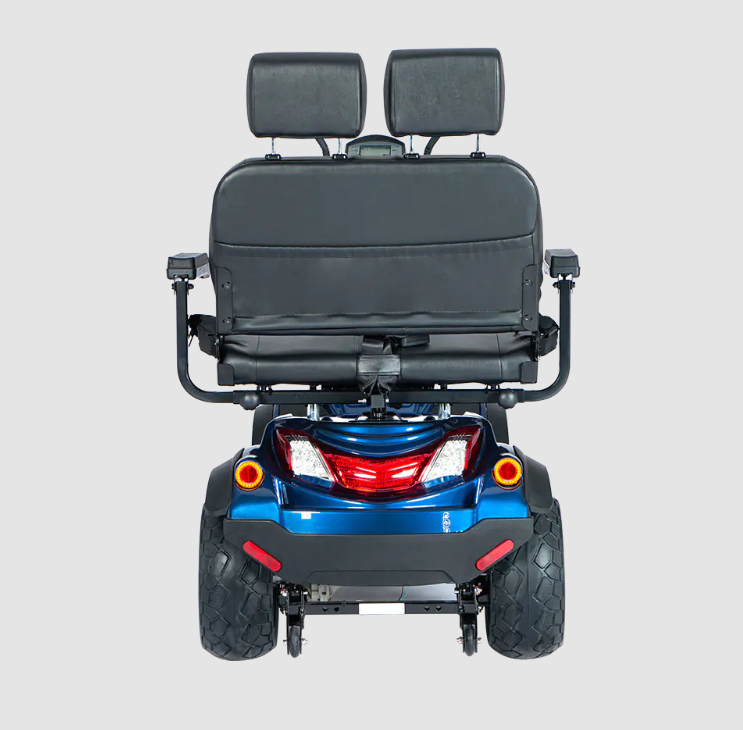
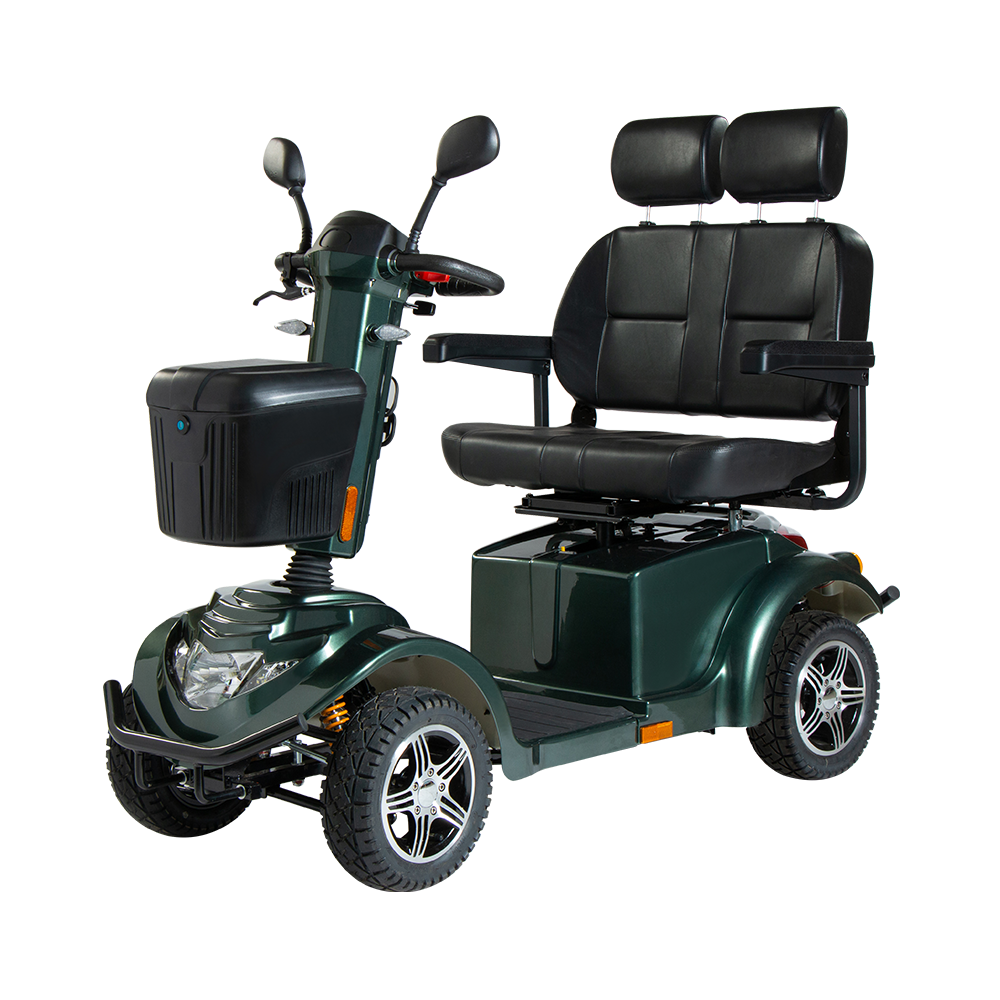
The defining production step for a Twin-Seat Mobility Scooter is the side-by-side seating layout, which places both occupants in the same lateral plane and shares a common forward view. Because both riders sit across the width of the vehicle rather than in a front-to-back line, the manufacturing process calls for an extended wheelbase and a wider chassis base to prevent rollover risk during turns. Welding teams reinforce the lateral support beams at the point where the seat frame attaches to the main chassis, since this junction absorbs the sway generated when two passengers shift position at different times. A side-by-side seating configuration also changes how the suspension is tuned, because the system must compensate for uneven weight distribution rather than a single centered load.
Drive System Adjustments for Combined Weight
Carrying two riders instead of one raises the combined load the motor and controller must move, so the drive system on a Twin-Seat Mobility Scooter line is calibrated differently from a single-seat platform sharing the same base chassis. Torque output is adjusted upward, and the controller firmware incorporates compensation algorithms that respond to lateral sway during acceleration. Braking hardware is also uprated, since stopping distance increases with combined passenger weight, and the parking-lock mechanism on inclines needs additional holding force to keep a companion mobility scooter stationary when loaded with two adults. None of these changes are cosmetic; each one traces back to a specific load calculation performed before the frame ever reaches the welding station.
Quality Control on Multi-Passenger Units
Testing protocols for a Twin-Seat Mobility Scooter differ from single-seat QC in one specific way: units are load-tested with weight distributed unevenly across both seats, not centered, because that is closer to how the vehicle will actually be used. Turning tests are run at varying combined weights to confirm the stability-torque compensation holds under real conditions, and braking distance is measured at rated load rather than at a lighter reference weight. A dual seat mobility scooter batch that passes centered-load testing alone would not reflect how the product performs once two people of different weights board it, so factories building for export markets typically document both loaded configurations separately in their QC records.
Comparing Seating Layouts by Manufacturing Demand
|
Manufacturing Factor |
Side-by-Side Layout |
Front-to-Rear Layout |
|
Chassis Width Change |
Significant increase |
Comparable to single-seat |
|
Primary Stress Point |
Lateral rollover risk |
Longitudinal pitch control |
|
Suspension Tuning |
Compensates uneven side loads |
Manages front/rear weight transfer |
|
Braking Demand |
Combined stopping distance |
Anti-pitch braking control |
|
Control System |
Unified single-driver logic |
Main/auxiliary role division |
Customization and Certification for Export Orders
Buyers ordering a Twin-Seat Mobility Scooter for markets with specific regulatory requirements typically request documentation covering frame load testing, motor certification, and braking system validation before placing a bulk order. Seat width, armrest structure, and upholstery material can be adjusted without altering the reinforced chassis design, which allows a factory to produce a reinforced drive system platform once and offer several seating finish options on top of it. This separation between structural engineering and surface customization keeps tooling costs down for distributors who want to test more than one seat configuration within a single production run, while the underlying safety-critical components remain unchanged across variants.
Sample units are typically evaluated before a full container order proceeds, and buyers should request the loaded-weight test records specific to a Twin-Seat Mobility Scooter rather than accepting single-seat certification documents as a substitute, since the two testing standards measure different failure points on the frame.

 No.58 Feiyang Road , Jinhua 321025, Zhejiang, China
 +86-13905796145
 +86-579-82268015