

 English
 中文简体
中文简体 Español
 Deutsch
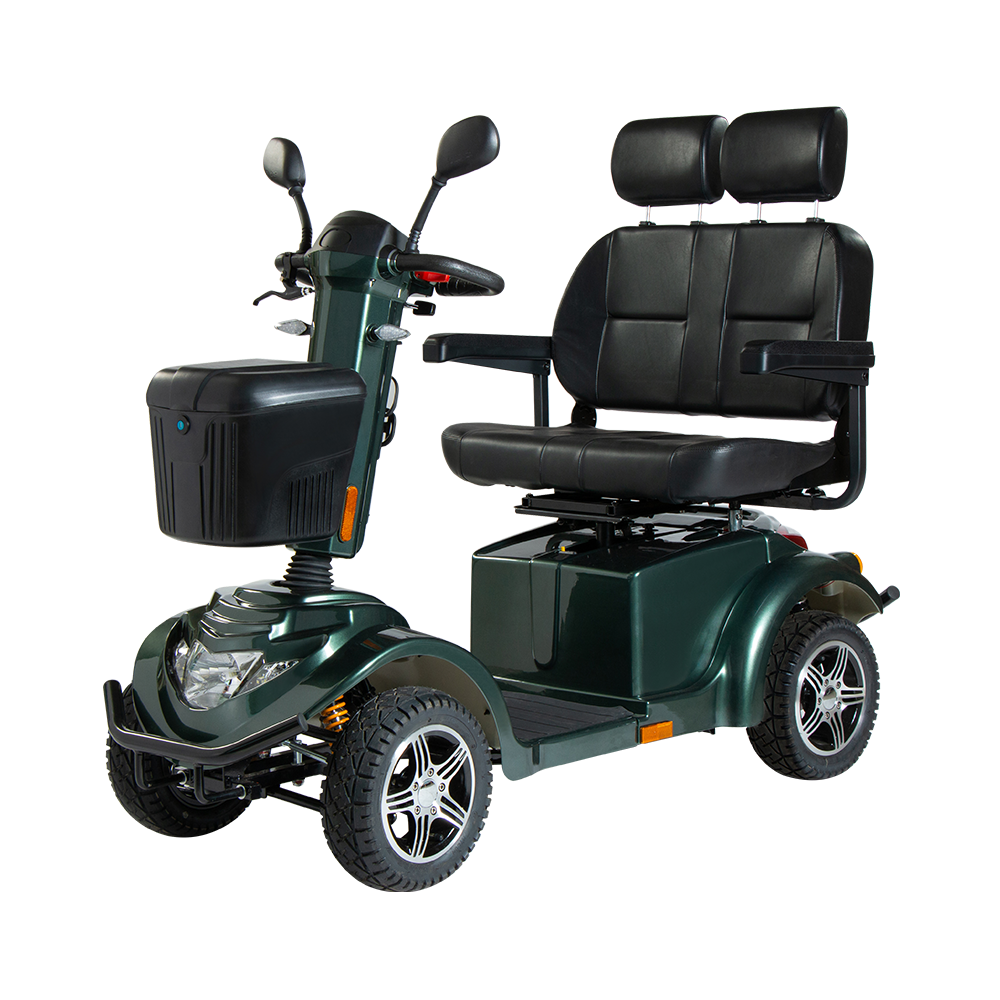
A type of electric mobility scooter capable of accommodating two users simultaneously is gradually gaining public visibility. Commonly referred to as "two-person electric mobility scooters," these devices are designed to meet the diverse needs of various scenarios, including accompanied travel, joint family mobility, and short-distance collaborative transit.
Within this niche sector, structural designs primarily fall into two categories: the "tandem" configuration—known as the Tandem Mobility Scooter—where seats are arranged one behind the other; and the "side-by-side" configuration—known as the *Side-By-Side Mobility Scooter*—where seats are positioned adjacent to one another. These two design approaches possess distinct characteristics regarding spatial layout, control mechanisms, and user experience, and together, they define the current trajectory for the development of two-person mobility devices.
The Context Behind the Rise of Two-Person Mobility Modes
Traditional single-person electric mobility aids primarily serve the needs of individual short-distance travel. However, in real-world usage scenarios, the need for accompanied travel has long been a persistent requirement. Examples include care-related travel between family members, traveling together during vacations, and the need for companionship during medical follow-up visits.
In these scenarios, single-person devices often necessitate traveling separately—a practice that not only reduces efficiency but also increases the costs associated with communication and coordination. Consequently, mobility aids capable of simultaneously transporting two people have begun to attract significant attention; their core value lies in enhancing the convenience of traveling together and improving collaborative mobility capabilities.
The advent of two-person electric mobility scooters has made "shared mobility" a reality, thereby transforming traditional travel patterns that previously relied on separate vehicles.
Tandem Mobility Scooters: Design Characteristics of the Longitudinal Structure
The Tandem Mobility Scooter employs a front-to-back, inline seating arrangement, wherein two passengers are positioned sequentially along a single axis. This structural layout is analogous to that of a tandem bicycle, though it has been optimized specifically for electric propulsion and stability control.
In terms of structural design, the front-to-back layout effectively limits the overall width of the vehicle, thereby granting it good maneuverability within narrow passageways, indoor environments, or areas with heavy pedestrian traffic. This design offers distinct advantages in usage scenarios that require frequent entry into buildings or public facilities.
The control system is typically centralized at the front seating position, with the front passenger assuming responsibility for steering and speed control, while the rear passenger focuses primarily on riding and assisting with balance. This division of roles simplifies the operational logic to a certain extent, making the device more accessible and easier to adapt to basic mobility requirements. However, due to the increased overall length, the design requires greater care regarding turning radii and spatial maneuvering to ensure stability during operation.
Side-by-Side Mobility Scooters: A Spatial Experience with a Parallel Configuration
Unlike the tandem configuration, the Side-by-Side Mobility Scooter features a parallel dual-seat design, allowing two passengers to ride side-by-side on the same lateral plane. This layout more closely resembles traditional seating arrangements and offers distinct advantages in terms of ease of communication.
The parallel structure enables passengers to maintain natural conversation while in motion, fostering a more interactive experience—particularly for accompanied travel or family use scenarios. Furthermore, from a visual perspective, this design closely mirrors standard seating layouts, thereby reducing the learning curve and making it easier for users to adapt.
In terms of handling, some designs still rely on a single control system to govern the vehicle's overall movement; however, other designs attempt to incorporate auxiliary control mechanisms, allowing both passengers to participate in the operation to varying degrees.
Due to their increased lateral width, these types of devices require more clearance when navigating narrow passageways; consequently, they demand more careful route planning when operating within complex urban environments.
Power Systems and Operational Controls
Whether for Tandem or Side-by-Side Mobility Scooters, the primary power source is typically an electric drive system. The motor output is regulated by a control module to ensure the vehicle maintains smooth operation under varying load conditions.
Accommodating two passengers entails an increase in overall weight; therefore, the power system typically requires enhanced output stability to effectively handle varying gradients and road surface conditions.
The battery system generally features a rechargeable design and supports multiple charging methods. In some models, the battery modules are detachable, facilitating independent charging and maintenance.
The control system prioritizes smoothness and safety, encompassing acceleration control, deceleration response, and basic braking functions. Some devices also incorporate speed-limiting mechanisms to adapt to different operating environments.
Comfort and Ride Experience Optimization
In terms of comfort design, two-passenger mobility scooters must simultaneously address the experience of both occupants; consequently, the seat structure places a strong emphasis on spatial allocation and ergonomic support.
For Tandem Mobility Scooters, the legroom and field of view for the rear passenger are particularly critical considerations; the structural layout must be carefully engineered to minimize any sense of confinement or crowding.
For Side-by-Side Mobility Scooters, the emphasis shifts to the balanced distribution of lateral space, ensuring that both passengers can maintain seating postures that are both relatively independent and harmoniously aligned. Some designs also incorporate adjustable backrests, shock absorption systems, and armrest structures to enhance comfort during prolonged use.
Safety Design and Stability Control
Due to their increased load capacity, two-person electric mobility scooters place higher demands on stability. Consequently, their safety systems typically feature multiple layers of protection.
A fundamental braking system is employed to ensure smooth stops while preventing the inertial shock associated with sudden braking. Some devices are also equipped with hill-assist functions to facilitate safe navigation on inclines and declines.
The vehicle's structural design prioritizes center-of-gravity control; by optimizing the placement of the battery and seating, the overall center of gravity is kept highly stable.
In terms of visibility, some models feature lighting systems and reflective markings to enhance their conspicuity in low-light environments.
Furthermore, certain designs incorporate a "low-speed stability mode," allowing the vehicle to operate more smoothly and safely in crowded or indoor settings.
Diversified Applications and Use Cases
The range of scenarios in which two-person electric mobility scooters are utilized is steadily expanding, focusing primarily on the following areas:
- In family settings, they enable elderly individuals and their caregivers to travel together, thereby enhancing the efficiency of caregiving.
- In medical environments, they facilitate the simultaneous movement of patients and their companions, minimizing inconvenience during transfers.
- In tourism and leisure contexts, the two-person configuration enhances the shared travel experience, ensuring a more seamless and continuous journey.
Within residential communities and public spaces, these devices are also gradually emerging as a complementary mode of transportation for short-distance travel.
Maintenance Management and Operational Guidelines
Given their increased structural complexity, two-person mobility scooters require more meticulous management regarding maintenance.
The battery system requires periodic inspection of its charging and discharging status to ensure stable performance. Similarly, the connecting components within the vehicle's structure must be kept in good condition to prevent loosening or wear.
The braking system and tire condition also require regular inspection to guarantee operational safety.
Furthermore, during operation, users should adjust the load and speed according to the actual environment, avoiding high-speed travel on complex or hazardous terrain.
This collaborative mode of two-person travel not only enhances the convenience of mobility but also, to a significant extent, enriches the structural diversity of urban micro-transportation systems.

 No.58 Feiyang Road , Jinhua 321025, Zhejiang, China
 +86-13905796145
 +86-579-82268015